
How to Choose the Right Creator Agency in 2027
9 min read · November 3, 2026 · By Jeremiah Rosen, Founder & CEO, Sundae Collective
The short answer: To choose a creator agency in 2027, judge finalists on what happens after the content is made, not on their creator roster. Ask nine questions: what business problem they'd solve first, how content gets into paid media, what share of their content actually runs, what usage rights you get, how they measure, whether it's a campaign or a program, how they vet creators, who staffs your account, and whether the work helps you show up in AI search.
A creator agency (also called an influencer marketing agency) plans, sources, briefs, licenses, and produces content with independent creators, and increasingly runs that content as paid media from the creators' own accounts.
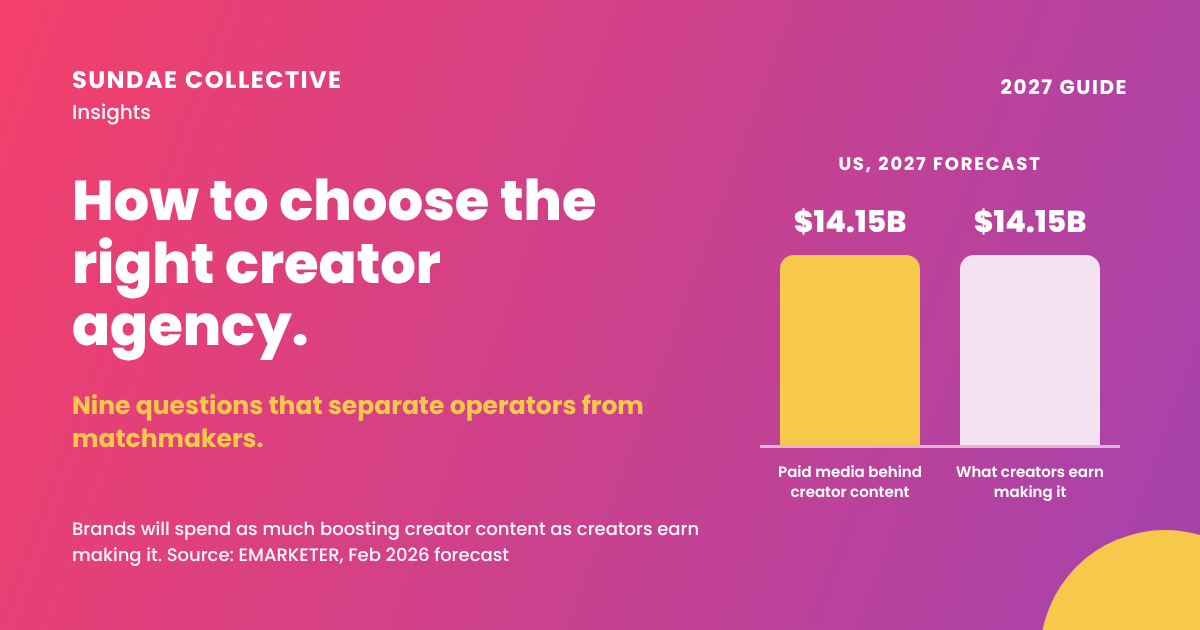
In 2027, US brands are forecast to spend as much putting paid media behind creator content as creators earn making it: about $14.15 billion each, according to EMARKETER. By 2028, amplification pulls ahead.
That one number should change how you pick a creator agency.
For most of the last decade, choosing an influencer agency meant choosing a matchmaker. Who has the roster. Who can land the creators. Who turns posts around fast. Those things still matter, and they are now the cheapest part of the job. The results sit in what happens after the content exists: whether it runs as media, whether it's licensed long enough to pay back, and whether anyone can tell you what it did.
This guide replaces our 2026 version. If you need the mechanics of writing the RFP itself, start with How to Draft the Perfect Influencer & Creator Marketing Agency RFP. This one covers the harder part: telling agencies apart once the proposals come in.
What changed going into 2027
Creator content became a paid media format. On Meta's October 2026 earnings call, CFO Susan Li said partnership ads grew more than 97% year over year and passed a $15 billion annual revenue run rate. In September, Meta folded Creator Marketplace and the Partnership Ads Hub into a single Creator Marketing Hub, with content permissions that carry their own expiration dates. Rights and paid operations used to be back-office details. They're now where programs win or lose.
The TikTok question got answered. TikTok's US business moved into a majority American-owned joint venture in January 2026, with ByteDance keeping 19.9%. “Should we be on TikTok?” is settled. “Are we too dependent on any one platform?” isn't, and a good agency plans for that.
People ask AI before they search. Answer engines lean on third-party content — reviews, YouTube videos, LinkedIn posts, creator explainers — when they summarize a category. Creator content that lives on after its 48 hours in the feed now does a second job. More on that in How Brands Use Creator Content for AI Search.
Nine questions that separate operators from matchmakers
Ask every finalist the same nine. The answers will sort them faster than any capabilities deck.
1. What business problem would you solve first?
Strong agencies restate your brief in business terms — rising CAC on Meta, soft consideration with 25–34s, a launch that needs credibility before reviews exist — and work backward to creators.
Red flag: the first slide is a creator roster.
2. How does creator content get into paid media, and who runs it?
The best creator agencies run content as paid media, not just organic posts. Partnership ads (still called allowlisting or whitelisting in most contracts) run your ad from the creator's handle, with your targeting and budget. In our own testing for an enterprise tech client, running creator content from creator handles was the single biggest performance lever we found — roughly a 4x improvement. A good answer covers who holds handle access, how permissions are requested and renewed, and how they decide which assets earn budget.
Red flag: “We hand the files to your media team.”
3. What share of the content you produced last year actually ran?
Ask for the deployment rate: the share of produced assets that ran as ads. In one audit we ran, only 7 of 27 produced creatives had ever been deployed. The most expensive asset in creator marketing is the one that never runs. Strong agencies know this number and have a system for raising it: a shared library your media team can pull from, a testing plan, a rotation schedule.
Red flag: they don't track it.
4. What usage rights do we get, for how long, and where?
Organic reposting, paid usage, term length, channels (Meta, TikTok, YouTube, CTV, retail media, OOH), and exclusivity are all separate line items. With Meta's expiring permissions, a 30-day term can quietly switch off your best-performing ad in week five. Rights should be negotiated before production, priced visibly, and tracked per asset. For what this costs, see How Much Does UGC Content Cost?
Red flag: “standard usage” with no term attached.
5. How will you measure success, and what would make you change course?
The metrics should match the objective: hold rate, CPC, cost per landing page view, and add-to-cart for performance; brand lift and search lift for awareness; matched-market tests when you need incrementality. Just as important is the decision rule — what result triggers a new hook, a new creator, or a budget shift.
If you want creator fees tied to outcomes, ask whether they've run performance-based pay. We break down one model in How to Pay Creators on Performance.
Red flag: reach and “earned media value” as the headline metrics on a performance brief.
6. Is this a campaign or an always-on program?
One-off flights restart learning every time. Programs keep returning creators, build audience familiarity, and test one variable at a time. A good testing plan holds creator, hook, format, setting, and CTA constant while it isolates the thing you actually need to learn. We wrote about why in Why One-Off Creator Ads Don't Build Trust.
Red flag: a new cast every quarter and no plan for what carries over.
7. How do you choose and vet creators?
Fit beats follower count. Micro and mid-tier creators usually win on credibility and cost per asset; larger creators earn their fee at reach moments like launches and tentpoles. Vetting should cover audience authenticity, brand-safety history, sponsorship density, and disclosure habits. If you sell to businesses, ask about LinkedIn and YouTube creators too — the sourcing, briefing, and measurement mechanics carry over.
One more thing: a platform seat is not a program. Self-serve creator platforms can generate a lot of posts quickly. Without strategy, editing, and paid behind them, they rarely add up to a result.
Red flag: selection by follower count or a platform search filter alone.
8. Who is actually on my account?
Ask for names, roles, and time allocation across strategy, creator management, creative, paid, and community management. The people in the pitch should be the people in the work.
Also ask who owns the program on your side, and how the agency plugs into that team. See Who Owns Your Creator Marketing Program?
Red flag: senior people present, junior people deliver.
9. Will this content help us show up in AI search?
This is an early discipline, so judge the thinking, not the promises. Good agencies consider where content lives after the feed — YouTube, LinkedIn, transcripts, owned pages — and which questions your buyers ask. See The Best Marketing You Do Won't Be Read By a Human First.
Red flag: anyone guaranteeing you'll rank first in ChatGPT.
A scoring model for 2027
We moved weight from culture fit toward paid media and content operations, because that's where results are decided now. If your brief is mostly awareness, shift five points from paid to creative.
| Criterion | Weight | What earns full marks |
|---|---|---|
| Paid media & optimization | 25% | Runs partnership ads in-house or with your media team; clear budget-allocation logic |
| Strategic fit | 20% | Frames the brief as a business problem; plan ties to your funnel |
| Creator selection & creative | 20% | Fit-based sourcing, rigorous vetting, strong hooks and edits |
| Content operations & rights | 15% | Rights priced and tracked per asset; knows its deployment rate |
| Measurement | 10% | Objective-matched metrics plus a stated decision rule |
| Team & working model | 10% | Named senior people with real time on the account |
Where Sundae fits
Sundae Collective is a New York–based creator agency that thinks like a brand agency and performs like a growth team. We start with the business problem, not the roster.
For ecobee, our client of more than five years, that approach has meant 200+ creators and 1,000+ assets, a 53% reduction in CPC, and creator content becoming the brand's top-performing paid media asset class. We run partnership ads in-house, and every asset lives in Scoops, our content platform, where both the brand and its media agency can find and use it.
We're the right call when creator content needs to work as media and you want one partner accountable from strategy through performance. If you need a one-time product seeding push with no paid media behind it, a specialist seeding shop will likely get you more for less.
Frequently asked questions
What questions should I ask an influencer marketing agency?
Ask how they'd frame your business problem, how content gets into paid media, what share of their content actually runs, what usage rights you get and for how long, how they measure, whether they run always-on programs, how they vet creators, who staffs your account, and how their work holds up in AI search.
What should a creator agency RFP include?
Brand background, business goals, audience, budget range, timeline, and specific asks on paid media, usage rights, and measurement. Our RFP guide walks through each section.
How much does a creator agency cost?
Most agencies price either as a monthly retainer for an always-on program or as a fixed project fee for a campaign. Creator fees, usage rights, and paid media budget are usually separate lines, so compare proposals on all three, not the agency fee alone. Our UGC pricing breakdown covers typical market ranges.
Should I hire a micro-influencer agency or a full-service creator agency?
If you mainly need product seeding and organic posts at volume, a micro-influencer specialist can be efficient. If you need creator content to run as paid media, with rights, testing, and reporting, you need an agency that handles the whole chain.
What's the difference between allowlisting, whitelisting, and partnership ads?
They describe the same practice: running paid ads from a creator's handle. Partnership ads is Meta's current product name; TikTok's equivalent runs on Spark Ads authorization codes. Contracts and agencies still use all three terms.
Do we need a creator agency if we already have a media agency?
Often, yes. Media agencies buy and optimize placements. Creator agencies source, brief, license, and produce the content those placements run. The best results come when both work from the same content library and the same performance data.
How long until a creator program shows results?
Paid creative tests can read within the first flight. The compounding benefits of a program — returning creators, a growing library of proven assets, audience familiarity — build over several quarters, which is why we push for always-on over one-off campaigns.
— Jeremiah Rosen, Sundae Collective
Sources:
- EMARKETER: Brands are about to spend more boosting creator content than creators earn making it
- PPC Land: Meta's ads with creators gain 97% to a $15bn annual run rate
- Elev8or: Meta merged Creator Marketplace and Partnership Ads into one hub
- Dawn: TikTok establishes joint venture to end US ban threat