
Who Owns Your Creator Marketing Program? What BCG's Top 15% Do Differently
3 min read · October 6, 2026 · Adapted from Sundae Tuesdae, Issue 28
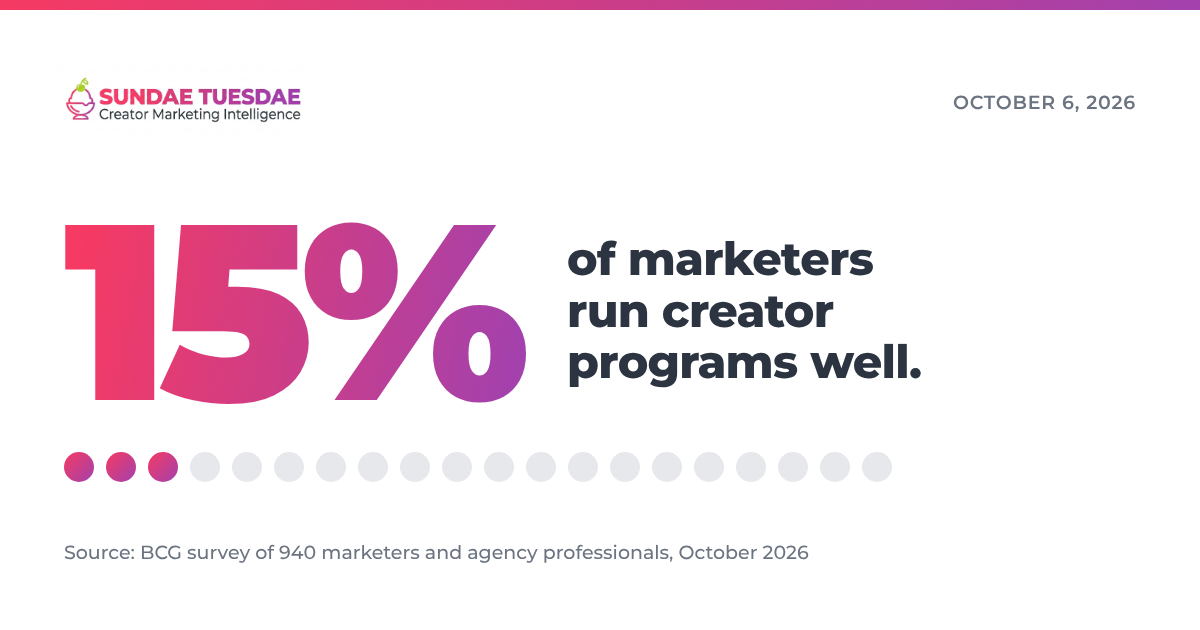
BCG surveyed 940 marketers and agency professionals and found that 15% run creator marketing well. What those leaders do differently reads like an org chart.
They are 1.5 times more likely to have one person accountable for each brand, and 1.3 times more likely to run creator marketing as its own function with four or more full-time staff. Strategy and creative direction stay in-house. Paid media gets planned alongside the creator fee, so a post that takes off already has budget behind it. Nearly 70% of companies have no dedicated creator team at all.
What BCG counts as a leader
BCG defines a high performer as a brand with 6% or more market share growth over three years, a 20% or greater increase in creator spend over the same period, and creator marketing ranked as a top-three brand-building channel. Two of those three criteria involve growing and spending more, so the study can't say whether the practices or the growth came first.
BCG also says brands integrating creator marketing effectively have achieved 19% lower CPA and 133% higher ROAS. The article does not say what those figures are compared against or how they were measured. It does report that only 6% of leading companies use advanced attribution, and that half still report reach and engagement as their primary success metrics.
So I read the performance numbers loosely and the organizational findings closely. The practices are the part a brand controls.
One owner, one budget
Naming an owner takes one meeting. The follow-through is consolidating creator fees, boosting, and affiliates into that person's budget, which BCG says frees up spend for cultural and viral moments.
CreatorIQ's new State of Creator Marketing report, fielded among 2,000 brand and agency marketers in nine countries, shows what that solves. Integration (27%), cross-team coordination (26%), and measurement (26%) ranked as nearly equal roadblocks. Each one is cross-functional work an accountable owner can take on.
The platforms are building for the same structure
Meta's new Creator Marketing Hub combines Creator Marketplace and the Partnership Ads Hub in one workflow. Brands can search for creators, grant content permissions with expiration dates, and create a draft partnership ad in one click. The creator relationship and the paid placement now sit in the same tool, which fits BCG's finding that leaders budget for boosting alongside the creator fee.
Creator work is also becoming a larger share of what brands make. SharkNinja says creators now produce 70% of its content.
A program someone answers for
A named owner turns a stack of creator posts into a program with a budget, a team, and someone to answer for the results. That is a satisfying thing to build, and the tools for it keep getting better.
— Jeremiah Rosen, Sundae Collective
Adapted from Sundae Tuesdae, Issue 28, which also covers L'Oréal's first TikTok Shop launch. Get Sundae Tuesdae every Tuesday.
Sizing a program of your own? Six questions size a starting paid social content plan. Try the Content Estimator.
Sources
- BCG, "The Power of Authenticity: How Leading Brands Are Pulling Ahead in Creator Marketing" (October 1, 2026)
- CreatorIQ, seventh annual State of Creator Marketing report (September 30, 2026)
- Meta, Creator Marketing Hub announcement
- Digiday, on SharkNinja's creator content (October 2, 2026)