
The State of the Gift Guide in 2026: Why Creator Gift Guides Work All Year
7 min read · November 23, 2026
In ten years of running creator programs at Sundae, I hadn't seen a creator number go down until this month. Digiday surveyed 90 brand and retailer marketers about their holiday plans, and use of gift guides fell 19 percentage points from last year. The same marketers ranked gift guides as their single best-performing holiday tactic, cited by 31%.
That's a strange thing to cut. It's even stranger when you look at what shoppers are doing, and at how many moments outside of December now run on the same format. Here's where the gift guide stands, why it works well beyond the holidays, and why AI search is giving it a second audience.
What is a gift guide?
A gift guide is a curated list of products picked for a person, an occasion or a price point, with every pick linked so the reader can buy it on the spot. "Gifts for the dad who grills." "Everything under $50." "What I'd buy on Prime Day." Magazines and department stores have published them for as long as there's been a holiday season.
A creator gift guide is the same idea made by an influencer, an affiliate creator or a UGC creator, and published where their audience already is: an Instagram carousel, a YouTube video, a TikTok, an LTK or Amazon storefront. The creator's name and taste do the work a magazine masthead used to do.
A haul is a different format. In a haul, a creator unboxes what they bought and reacts on camera. A haul centers on the creator's own shopping, while a gift guide is built around someone else's list, which is a big part of why shoppers save them.
Why brands cut gift guides this holiday
The Digiday survey doesn't say whose gift guides marketers dropped. It could be their own, paid placements in publisher guides or guides made with creators. What it does show is where the plans went: 45% of marketers plan CTV and streaming ads this holiday, up from 23% last year, and 33% plan TV ads, up from 13%.
None of this reads as brands cooling on creators. Madison & Wall estimates brands will spend $116 billion on creators this year, up 15%. My guess is the gift guide line got borrowed against for a TV buy in a tight budget year. A format that sits between the social team, the affiliate team and the e-commerce team is an easy line to trim when nobody fully owns it.
Shoppers kept using them
Syracuse University's Center for the Creator Economy surveyed 988 U.S. adults in early November. 77% save gift ideas from creators, mostly with someone else in mind. Half bought something on a creator's recommendation last holiday season, including 37% on Black Friday. Instagram (60%), YouTube (59%) and TikTok (53%) are where those saved ideas live.
My favorite finding from that report: 70% call creators' holiday deal posts "mostly just advertising," and 53% say creators help them find deals that are actually worth it. Shoppers know exactly what they're looking at. They save it anyway, because the creator did the looking for them.
Adobe expects influencers and creators to drive 22% of affiliate traffic to U.S. retail sites this holiday season, second only to cashback and rewards programs.
The gift guide calendar runs all year
The holidays get the attention, but the same behavior shows up every time there's a reason to buy for someone, or for yourself.
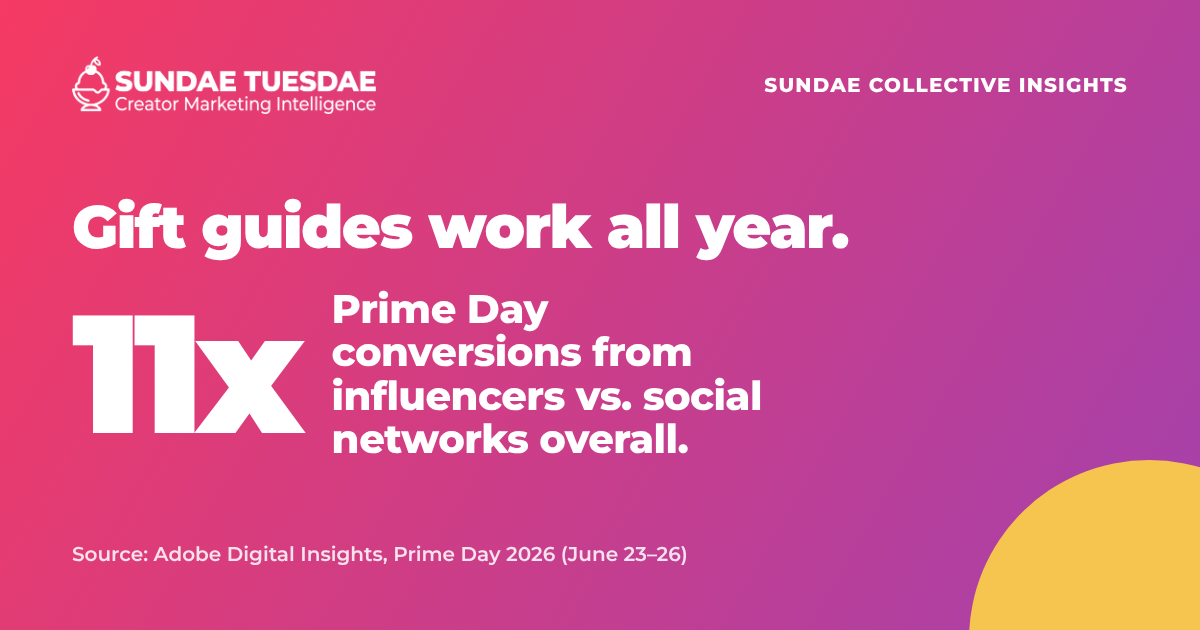
Prime Day. U.S. shoppers spent $26.4 billion online during Amazon's four-day event in June, according to Adobe. Affiliates and partners, a category that includes social media influencers, drove 21.3% of revenue, up 7% year over year, and Adobe found influencers converted shoppers 11 times more than social networks overall. "What I'd actually buy on Prime Day" is a gift guide with a deadline.
Mother's Day. The NRF expected record Mother's Day spending of $38 billion this year. In Optimove's survey of higher-income shoppers, 49% said they regularly use AI tools for gift ideas, which matters for the AI point below.
Father's Day. Spending was expected to hit a record $27.9 billion, per the NRF. In PwC's survey, 27% of shoppers named social media as a source of gift inspiration, and Gen Z was the generation most likely to shop for Father's Day gifts through social (36%). GlobalData's Neil Saunders has noted that people find it harder to come up with good gift ideas for Father's Day than for many other occasions, which is exactly the problem a good gift guide solves.
Everything in between. Valentine's Day, graduation, back-to-school, birthdays and housewarmings all follow the same pattern: a shopper with a person in mind and no idea what to buy. A creator who knows that person's type ("the friend who just got into running") is the shortest path to a purchase.
Why AI search reads gift guides
There's a newer reader for these lists. Ritual's chief growth officer told Digiday she's bullish on gift guides because AI shopping tools lean on best-of lists and curated recommendations.
The research backs her up, with a caveat. In an Ahrefs study of 750 shopping and software prompts, "best X" lists made up 43.8% of the pages ChatGPT cited. Peec AI found that ChatGPT quietly adds words like "best" and the current year to the searches it runs behind the scenes, which favors fresh, dated lists. Seer Interactive has tracked ChatGPT citing fewer self-serving listicles this year while Google's AI Overviews hold steady, so lists that read like a brand ranking itself first are losing ground.
That's an opening for creator gift guides. A guide made by a creator with real picks, real reasons and a date on it is the kind of third-party, recommendation-shaped content these systems look for. A creator's guide your aunt saves in November could be the list an assistant hands your cousin in December.
What a creator gift guide that gets found looks like
From what we see across programs, the guides that keep working past the first week share a few traits:
- The occasion, the person and the price are in the title. "Father's Day gifts for the dad who grills, under $75" matches how people search and how AI tools rewrite their queries.
- Every pick has a reason. One sentence on why it made the list gives a shopper confidence and gives an AI system something to quote.
- It's dated and refreshed. "2026" in the title and an updated date on the page help with the recency signals AI search favors.
- It lives in more than one place. The creator's post, the creator's storefront and a version on the brand's own site, which takes usage rights agreed at the start.
- It's planned around the calendar. A guide that goes up the week before Mother's Day misses the shoppers who started looking three weeks out.
The opportunity
The gift guide is doing more work than it ever has, for shoppers and now for the AI tools they ask, in the same season a lot of brands decided to sit it out. That makes it one of the less crowded formats in creator marketing right now, at the moments when people are most ready to buy.
Frequently asked questions
What is the difference between a gift guide and a haul?
A gift guide is a curated list of products for a person, occasion or budget, built for the reader to shop from. A haul is a creator unboxing and reacting to their own purchases. Shoppers tend to save gift guides and come back to them when it's time to buy.
When should brands publish gift guides?
Ahead of every major gifting or shopping moment: the holiday season, Prime Day, Valentine's Day, Mother's Day, Father's Day, graduation and back-to-school. Shoppers start researching weeks before the date, so guides work best when they're live early.
Do AI assistants like ChatGPT use gift guides?
They often cite curated "best of" lists when answering shopping questions. In an Ahrefs study, "best X" lists made up 43.8% of the pages ChatGPT cited for top-of-funnel prompts. Third-party, recently dated lists tend to fare better than lists where a brand ranks itself first.
Are creator gift guides worth it for brands?
Shoppers act on them. Syracuse University found half of U.S. adults bought on a creator's recommendation last holiday season, and Adobe found influencers converted shoppers 11 times more than social networks overall during Prime Day 2026.
This post grew out of Sundae Tuesdae, our weekly creator marketing briefing for brand builders. Subscribe here.
Sundae Collective runs managed creator commerce programs across affiliate, ambassador and TikTok Shop. See what we do.
Sources
- Digiday+ Research, holiday marketing tactics (Nov 23, 2026)
- Syracuse University Center for the Creator Economy, Flash Report No. 2 (Nov 2026)
- Digiday, Madison & Wall creator spend (Nov 18, 2026)
- Adobe, 2026 holiday forecast (Sept 28, 2026)
- Adobe, 2026 Prime Day results
- NRF, Father's Day 2026
- eMarketer on NRF Mother's Day 2026 and Optimove
- PwC Father's Day 2026, via Chain Store Age
- GlobalData's Neil Saunders, via Inside Retail
- Ahrefs, "best" lists and ChatGPT citations
- Peec AI fan-out study, via PPC Land
- Seer Interactive, listicle citations in AI search